
2026–27 calendar of events
To download a pdf of the 2026-27 program, click here.
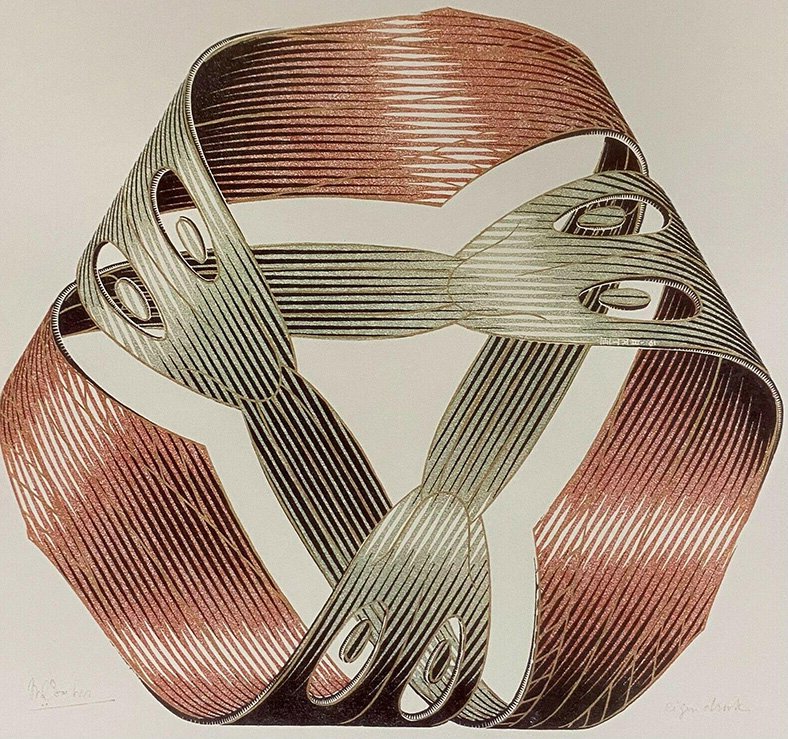
One Loop, or Two? On the Topology of the Möbius Strip—Mauro Milanaccio
For Lacan, the subject of the unconscious is structured like a Möbius strip: internal and external form a continuum. The Lacanian unconscious, “structured like a language,” is not, as Freud would have it, an inner domain; conscious and unconscious processes coexist on one and the same surface.
Spinoza: Ethics as Desire—Raffaella Colombo
The third part of Spinoza’s masterpiece Ethics deals with the “Origin and Nature of the Emotions.” In this crucial section the Dutch philosopher reveals, in geometric fashion (more geometrico), his largely revolutionary ideas on the mind-body relationship and on the role of “affects” in the formation of our identity and our moral sense.
From Unfulfilled Promise to Cause-of-Desire—Paula Hochman
The verb “to be” tempts subjects to think they can attain the wholeness of Being. But the symbolic order is founded on lack, as subjects discover whenever the jouissance they do obtain falls short of the one they expected. One can subjectivize this disappointment in two ways: by neurosis, which clings to the Other’s broken promise of being; or by desire, which leads subjects to construct a singular object (what Lacan called object a) that brings them a surplus of jouissance.
The Analyst’s Transference—Alain Vanier
Nothing is more commonplace than transference in all its manifestations — love, hate and ignorance. And yet, for all its ubiquity, transference is the specific, fundamental tool of psychoanalysis. How can we situate and address it from the perspectives of both the analysand and the analyst?
Fact in the Clinic and in Science—André Michels
For all their basic differences, clinical facts and scientific facts are remarkably close, and overlap in several areas. Both have a special relation to knowledge, with criteria based on validity rather than truth. As with science, the clinic’s kernel lies in repetition, revealing the real in all its variations. There, knowledge can be unknotted and reknotted differently. Yet, clinical or scientific discovery comes about as a result of an intrinsic logic and not by chance, within a mode of thought that reckons with each subjective position.
Mimicry and the Temptations of Space—Daniel Heller-Roazen
“The Mirror Stage” contains a reference to an article by Roger Caillois on mimicry. This presentation will explore the role of Caillois’s concept of mimicry and the “temptation of space” in Lacan’s writing, while bearing in mind the contrasting theory of the “mimetic faculty” Walter Benjamin developed in the same years.
dates to be announced

Memoria dell’utopia: Gramsci e noi—Angelo Villa
This biography of the revolutionary thinker Antonio Gramsci encompasses his Sardinian childhood marked by poverty and illness; his years of study, intellectual production and political activism; and his last years of imprisonment under Fascism which failed to deflect his fundamental drive toward the future.
On Child Psychoanalysis Today—Angelo Villa
Child psychoanalysis, ever since Freud’s time, has been a testing ground for our field, serving to question the basic premises of psychoanalysis. While inextricable from intergenerational history, it is also firmly marked by contemporary issues and new forms of symbolization. This workshop will focus on the analyst’s obligation to respond inventively to new symptoms in children and remain open to the unexpected.